Tazzarte
Bayeux Tapestry: Halley's Comet, 1066 – Porcelain Art Mug
Bayeux Tapestry: Halley's Comet, 1066 – Porcelain Art Mug
Couldn't load pickup availability
- ✓ Free worldwide shipping
- ✓ 30-day returns
- ✓ Damaged? Free replacement, no return needed
- ✓ Printed and shipped from the hub nearest you — no customs, no long wait
The price you see is the price you pay — taxes included, nothing added at checkout. Shipping · Returns · Help
Share
wool embroidery on linen
Spring, 1066. A comet blazes across the night sky over England. Men stand rooted to the ground, arms flung upward, unable to look away. "Isti mirant stella" — these men marvel at the star — reads the stitched inscription above their heads. A few paces on in the embroidered narrative, King Harold sits at Westminster as a messenger leans close to deliver the news.
This is Scenes 32–33 of the Bayeux Tapestry: the most celebrated panels of the most famous medieval artwork in existence. Probably commissioned within years of the Norman Conquest by Bishop Odo of Bayeux — William the Conqueror's half-brother — the nearly seventy-metre wool-on-linen chronicle recorded the events of 1066 with dramatic economy. The comet, Halley's, had been observed by chroniclers across Europe and Asia that spring. In the tapestry, it is unambiguously an omen. At Hastings in October, the omen proved correct.
From 10 September 2026 to 11 July 2027 the tapestry is on view at the British Museum in London – the first time it has been shown in England since it was made. The panel at the centre of the attention is the one wrapped around this mug. Tazzarte is not affiliated with the British Museum or the exhibition.
Reproduced from a photograph of the original eleventh-century embroidery. The wool was dyed with three plants — madder for the reds, woad for the blues, weld for the yellows — and nine hundred years have taken the edge off all three. The colours here have been lifted back so that they read with full intensity on white porcelain.
The fifth product image shows the same scene as Charles Stothard engraved it. The Society of Antiquaries of London sent him to Bayeux in 1816 to copy the whole tapestry; James Basire cut the plates, and their publication in 1821–23 was the first time a complete colour reproduction had been put before the public. Stothard drew the embroidery after the damage of the Revolution and before the nineteenth-century repairs — which is why his plates are still the reference for what is original stitching and what is later mending. One thing he did not draw: a fragment left Bayeux during the campaign and surfaced in London. The South Kensington Museum sent it back on 14 August 1872. Who removed it has never been settled.
The first of a series of three: the comet, then the Norman charge at Hastings and the death of Harold, where the omen is fulfilled. All three together: Bayeux Tapestry: The Comet and the King.
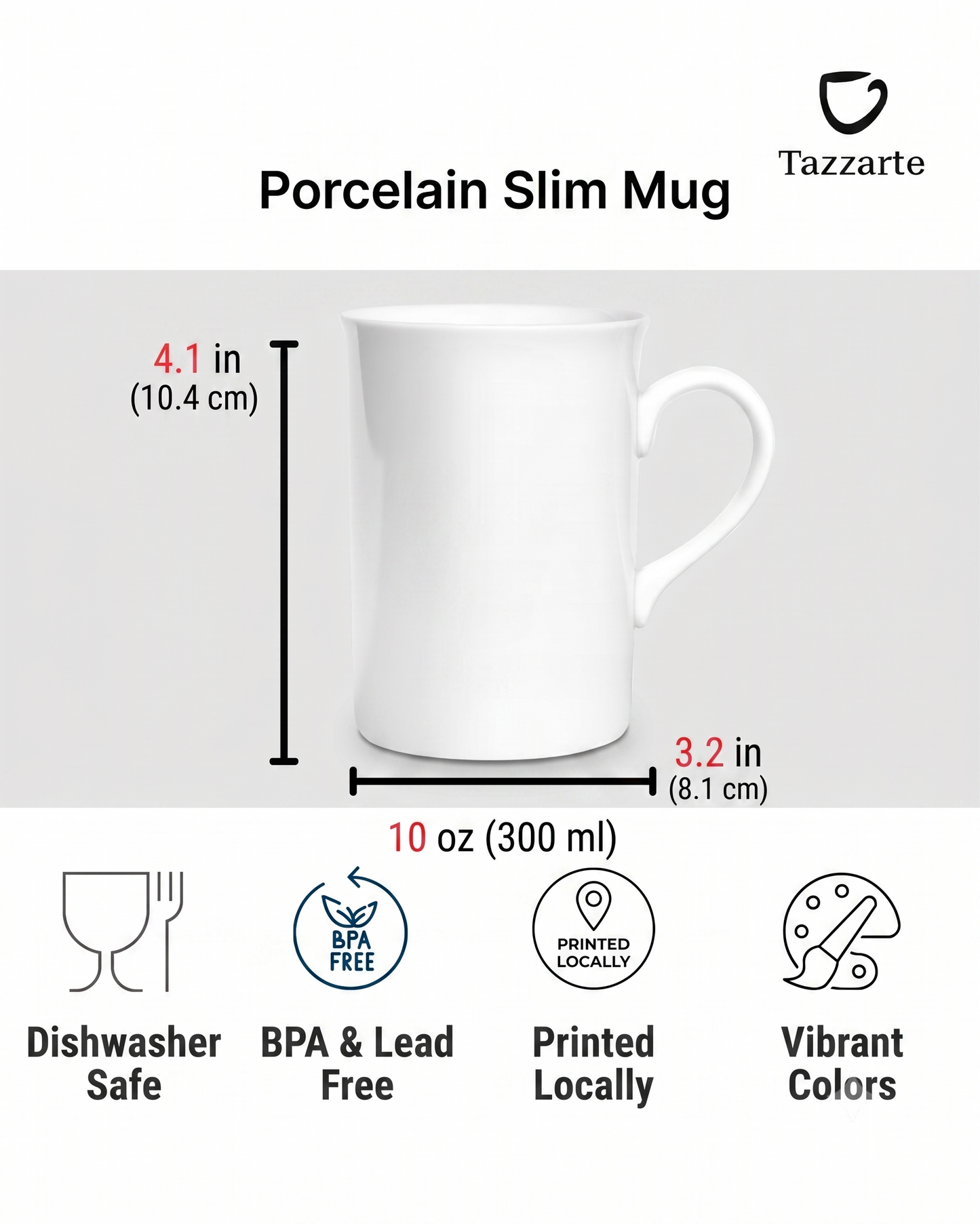
Fine porcelain, 10 oz — 104 mm high, 75 mm across the base. Light in the hand, about 200 g, with a thin, smooth rim: lighter than a diner mug, finer at the lip. If you want a heavy café mug, this is the wrong one. The image runs around the body; handle and rim stay white. Dishwasher and microwave safe.
Bayeux Tapestry, scenes 32–33, wool embroidery on linen, c. 1070s, Bayeux, Normandy. Photographic campaign 2017 (Université de Caen Normandie, CNRS, ENSICAEN), Wikimedia Commons; public domain. Fifth image: Charles Alfred Stothard, The Tapestry of Bayeux, engraved by James Basire, Society of Antiquaries of London, 1821–23; Internet Archive, Public Domain Mark 1.0.
Selected by Dr. Walther Fuchs for the Tazzarte collection.