Tazzarte
Vincent van Gogh: Sunflowers, 1887 – Porcelain Art Mug
Vincent van Gogh: Sunflowers, 1887 – Porcelain Art Mug
Couldn't load pickup availability
- ✓ Free worldwide shipping
- ✓ 30-day returns
- ✓ Damaged? Free replacement, no return needed
- ✓ Printed and shipped from the hub nearest you — no customs, no long wait
The price you see is the price you pay — taxes included, nothing added at checkout. Shipping · Returns · Help
Share
Sunflowers, Paris, 1887
Oil on canvas, 43.2 x 61 cm
The Metropolitan Museum of Art, New York, Rogers Fund, 1949, inv. 49.41
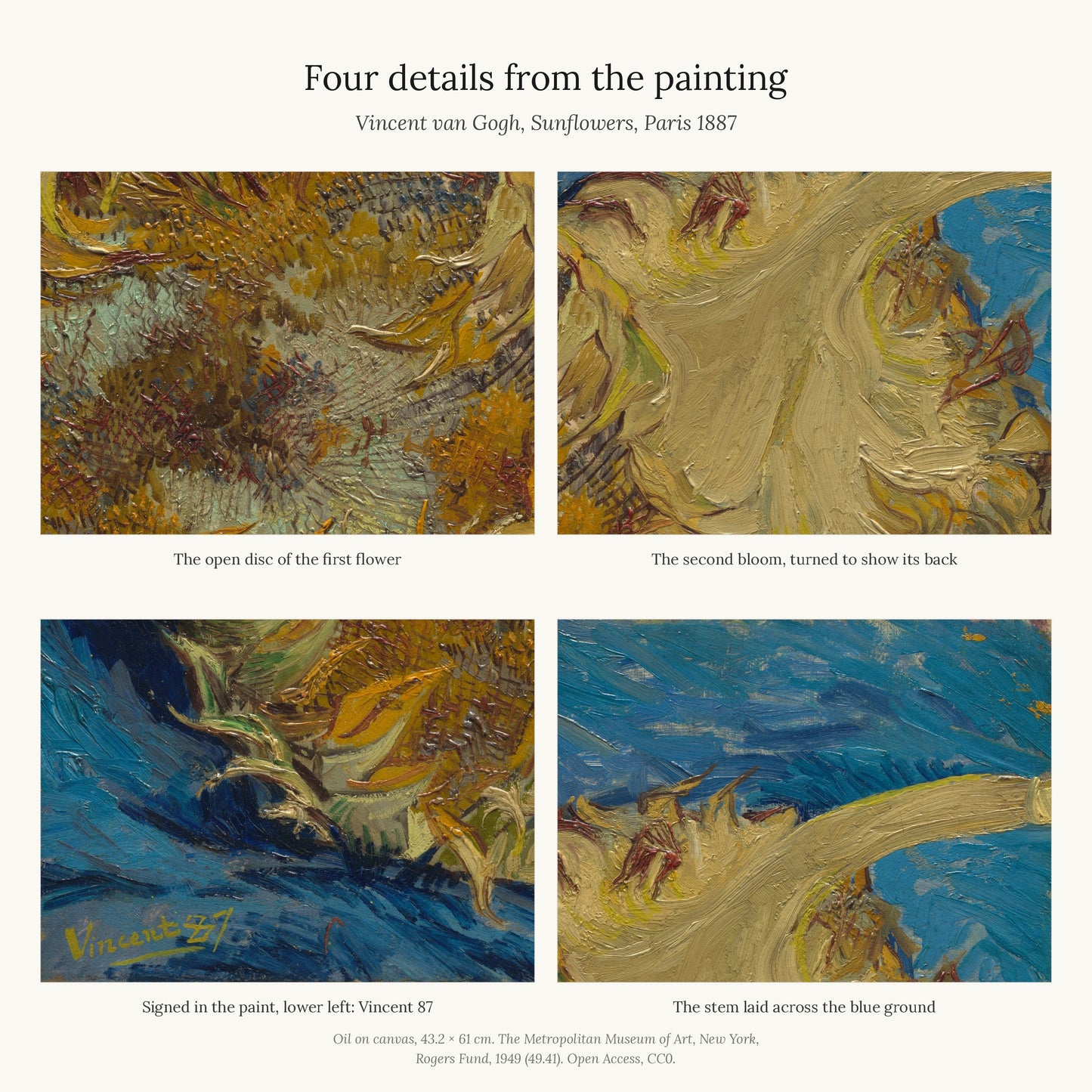
Two sunflower heads lie on a blue ground, cut and already past their best. One still shows its disc, the seeds packed in a spiral under a haze of pale paint. The other has turned right over, so that what faces out is the back of the flower, petals splayed and bleached. Nothing holds them — no vase, no table, no horizon. Van Gogh laid them down and brushed the blue around them thickly enough that you can still see where the brush turned.
Paris, late summer 1887. He painted four canvases of cut sunflowers that season: a small study, this one, a second pair now in Bern, and a larger sheet of four heads now in Otterlo. They are the sunflowers before the sunflowers — a year older than the vases he painted in Arles, which is what most people mean by the word.
Gauguin took two of them, in an exchange made that winter. The two small canvases hung above his bed in his Paris apartment until the mid-1890s, when he sold his best things to the dealer Ambroise Vollard to pay for the South Seas. This is one of the two. Later, when Gauguin asked for one of the Arles sunflowers as well, Van Gogh refused — Gauguin had two already.
The blue is what makes the yellow work. Van Gogh had spent his Paris months on complementary colour, testing it canvas by canvas, and here the whole ground is given over to the argument. He signed in the paint at the lower left, in yellow on the blue: Vincent 87.
The mug carries the painting edge to edge, cropped just inside the worn edge of the canvas, at the proportions of the original — 43.2 by 61 centimetres.
The fourth product image shows four details at close range: the open disc, the turned bloom, the signature, and a stem laid across the blue.
Fine porcelain, 10 oz — 104 mm high, 75 mm across the base. The image runs around the body; handle and rim stay white. Dishwasher and microwave safe.
From the same series: The Bedroom, 1889 · Irises (Detail), 1889
Vincent van Gogh, Sunflowers, Paris, 1887. Oil on canvas, 43.2 × 61 cm. The Metropolitan Museum of Art, New York, Rogers Fund, 1949 (49.41). Open Access, public domain.
Selected by Dr. Walther Fuchs for the Tazzarte collection.