Tazzarte
William Morris: Tulip, 1875 – Porcelain Art Mug
William Morris: Tulip, 1875 – Porcelain Art Mug
Couldn't load pickup availability
- ✓ Free worldwide shipping
- ✓ 30-day returns
- ✓ Damaged? Free replacement, no return needed
- ✓ Printed and shipped from the hub nearest you — no customs, no long wait
The price you see is the price you pay — taxes included, nothing added at checkout. Shipping · Returns · Help
Share
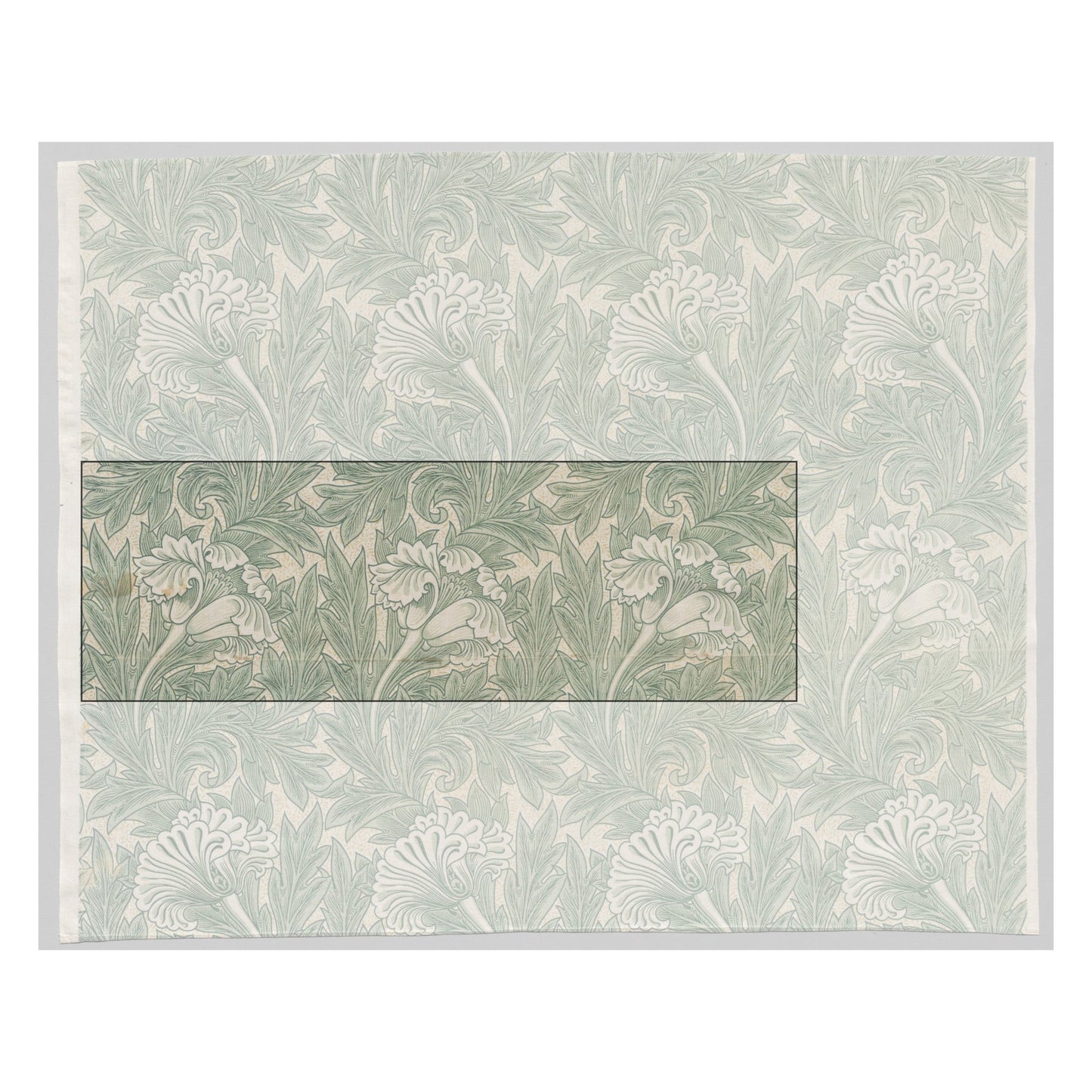
Tulip, 1875
Roller-printed cotton, 76.1 x 95.3 cm
The Cleveland Museum of Art, Gift of Mrs. Philip White, inv. 1937.579
Morris designed Tulip in 1875, in the years when he was teaching himself to dye and print by hand but did not yet have a printworks of his own — that came with Merton Abbey in 1881, so this pattern was still produced for him by a commercial firm. It is one of the designs he built on an older source: the swaying symmetrical stems and the turned-over leaves come out of the Italian cut velvets he studied at the South Kensington Museum.
It is a roller print — the cloth drawn between engraved copper rollers, one for each colour — which is why it reads more finely than the wood-block prints Morris made later at Merton Abbey. The pattern was sold in several colourways and on more than one cloth; this length is the pale green on cream. Tulips rise between broad acanthus leaves, and behind them a fine scrolling stem fills the ground so that nothing is left empty.
The mug carries the pattern as a frieze, at roughly a third of life size. Tulip is a mirrored pattern, so the section was set by the flowers and not by the repeat: one whole tulip stands at the centre of the front — the opened bloom, the bud beside it and the long flower turning down out of the same stem — uncut, with the mirrored pair falling away to either side.
Fine porcelain, 10 oz — 104 mm high, 75 mm across the base. The image runs around the body; handle and rim stay white. Dishwasher and microwave safe.
From the same series: Strawberry Thief, 1883 · Kennet, 1883
William Morris, Tulip, 1875; roller-printed cotton. 76.1 × 95.3 cm. The Cleveland Museum of Art, Gift of Mrs. Philip White, 1937.579. Public domain (CC0).
Selected by Dr. Walther Fuchs for the Tazzarte collection.