Tazzarte
Wilson Bentley: Snow Crystal No. 1018, before 1903 – Porcelain Art Mug
Wilson Bentley: Snow Crystal No. 1018, before 1903 – Porcelain Art Mug
Couldn't load pickup availability
Share
Wilson Bentley was a farmer in Jericho, Vermont, in the snowbelt — about three metres of snow a year. His mother taught him at home. For his fifteenth birthday, in 1880, he was given a microscope. He spent the next years trying to draw what he saw in it, and failing.
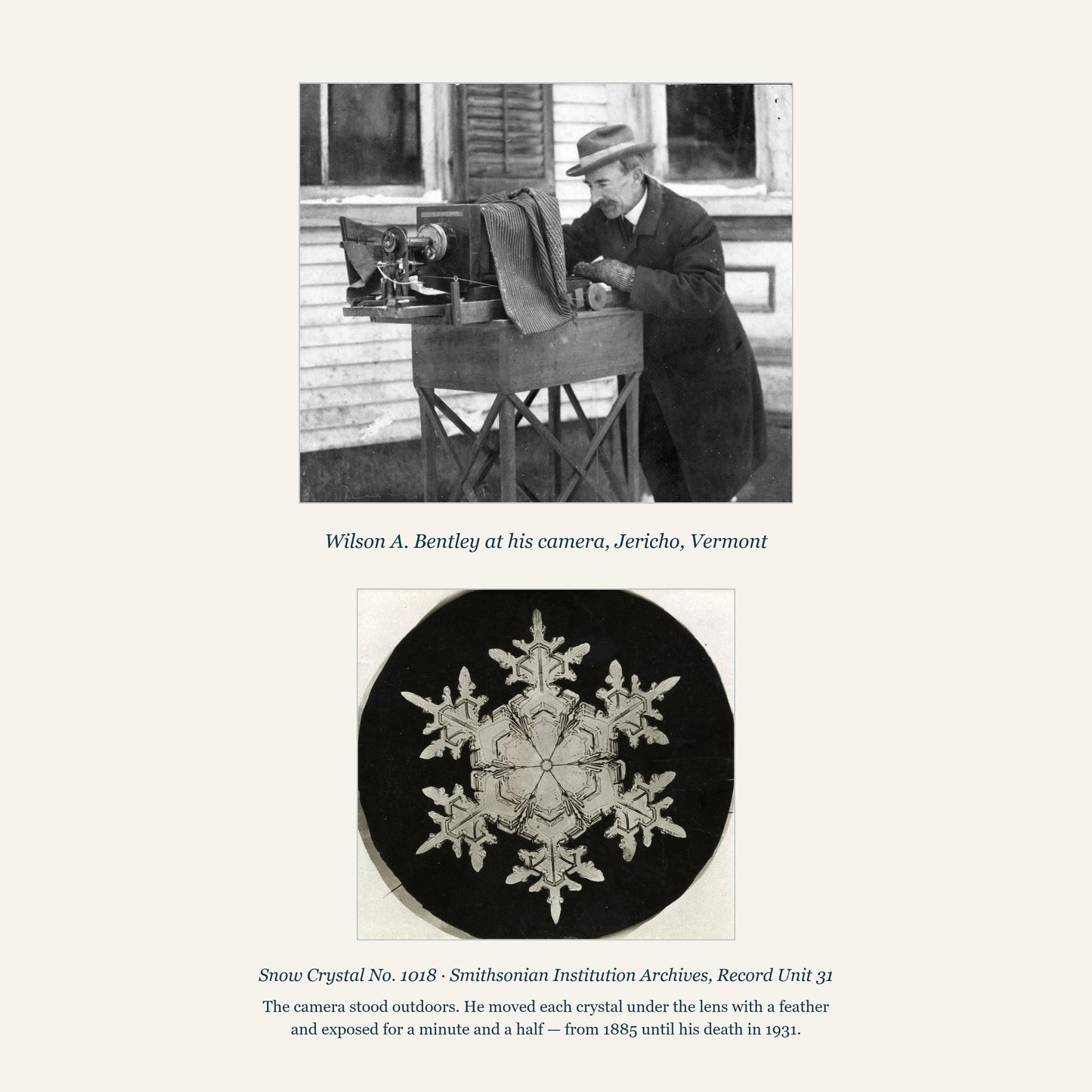
Then he connected a bellows camera to the microscope. In 1885, aged nineteen, he made the first photograph of a snow crystal that anyone had ever made.
The apparatus stood outdoors, because indoors the specimens melted. He waited in the cold, caught the falling flakes on a board, moved them under the lens with a feather, and exposed for a minute and a half. He did this for forty-six winters and photographed more than five thousand crystals. From that collection came the sentence everyone now repeats without knowing whose it was: no two are alike.
This is his No. 1018. A stellar crystal, six arms, each arm carrying the same plates and ribs and each one carrying them differently. Bentley cut the crystal out of the print and mounted it on black card — that is why the field is a dark disc and why the corners are cream. The cut edge and the card are his working method, and they are left as they are.
In 1903 he sent five hundred of these prints to the Smithsonian Institution, to its third Secretary, Samuel Pierpont Langley. He wrote that he was grateful to have his collection placed beyond all possibility of loss and destruction, through fire or accident. This sheet is one of those five hundred.
Fine Porcelain — 10 oz. Dishwasher and microwave safe.
Wilson Alwyn Bentley (1865–1931), Photomicrograph, Stellar Snowflake No. 1018, before 1903. Smithsonian Institution Archives, Record Unit 31, Image No. SIA2013-09154. CC0.
Selected by Dr. Walther Fuchs for the Tazzarte collection.