Tazzarte
Wilson Bentley: Snowflake, c. 1905 – Porcelain Art Mug
Wilson Bentley: Snowflake, c. 1905 – Porcelain Art Mug
Couldn't load pickup availability
- ✓ Free worldwide shipping
- ✓ 30-day returns
- ✓ Damaged? Free replacement, no return needed
- ✓ Printed and shipped from the hub nearest you — no customs, no long wait
The price you see is the price you pay — taxes included, nothing added at checkout. Shipping · Returns · Help
Share
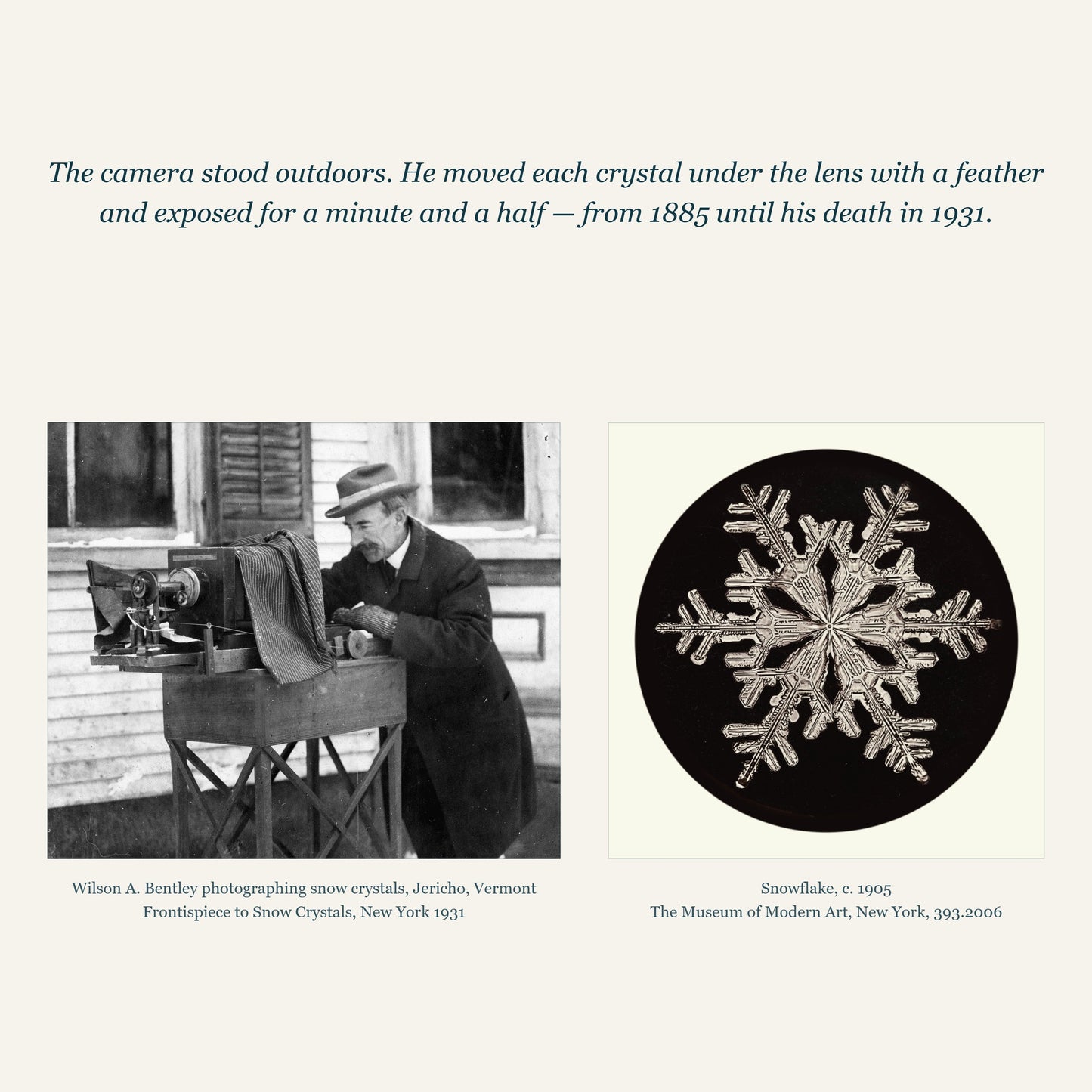
Snowflake, c. 1905
Gelatin silver printing-out-paper print, 10.1 x 7.6 cm
The Museum of Modern Art, New York, inv. 393.2006
Wilson Bentley was a farmer in Jericho, Vermont, in the snowbelt — about three metres of snow a year. His mother taught him at home. For his fifteenth birthday, in 1880, he was given a microscope. He spent the next years trying to draw what he saw in it, and failing.
Then he connected a bellows camera to the microscope. In 1885, aged nineteen, he made the first photograph of a snow crystal that anyone had ever made.
The apparatus stood outdoors, because indoors the specimens melted. He waited in the cold, caught the falling flakes on a board, moved them under the lens with a feather, and exposed for a minute and a half. He did this for forty-six winters and photographed more than five thousand crystals. From that collection came the sentence everyone now repeats without knowing whose it was: no two are alike.
This one is a stellar dendrite, and it is as near to perfect as his plates come. Six arms of equal length, each carrying the same paired branches at the same angle, each branch ending in a small flat plate. At the centre, a hexagon the size of a pinhead. The crystal was on the ground for a few seconds and then gone; the photograph is all that is left of it.
Bentley cut the crystal out of the print and mounted it on dark card. That is why the field is a black disc on a pale ground. He did this five thousand times over forty-six winters, in an unheated shed behind the farmhouse.
This print was made around 1905 and came to the Museum of Modern Art in New York a century later, acquired in memory of John Parkinson III through the generosity of his friends. It is 10.1 by 7.6 centimetres — the size of a postcard.
Fine porcelain, 10 oz — 104 mm high, 75 mm across the base. The image runs around the body; handle and rim stay white. Dishwasher and microwave safe.
From the same series: Frost, c. 1910 · Dew on a Spider Web, c. 1910
Wilson A. Bentley (1865–1931), Snowflake, c. 1905. Gelatin silver printing-out-paper print, 10.1 × 7.6 cm. The Museum of Modern Art, New York, 393.2006. Public domain.
Selected by Dr. Walther Fuchs for the Tazzarte collection.