Tazzarte
Andreas Cellarius: Planisphaerium Copernicanum, 1661 – Porcelain Art Mug
Andreas Cellarius: Planisphaerium Copernicanum, 1661 – Porcelain Art Mug
Couldn't load pickup availability
- ✓ Free worldwide shipping
- ✓ 30-day returns
- ✓ Damaged? Free replacement, no return needed
- ✓ Printed and shipped from the hub nearest you — no customs, no long wait
The price you see is the price you pay — taxes included, nothing added at checkout. Shipping · Returns · Help
Share
Planisphaerium Copernicanum, 1661
Zentralbibliothek Zürich, T 12, doi
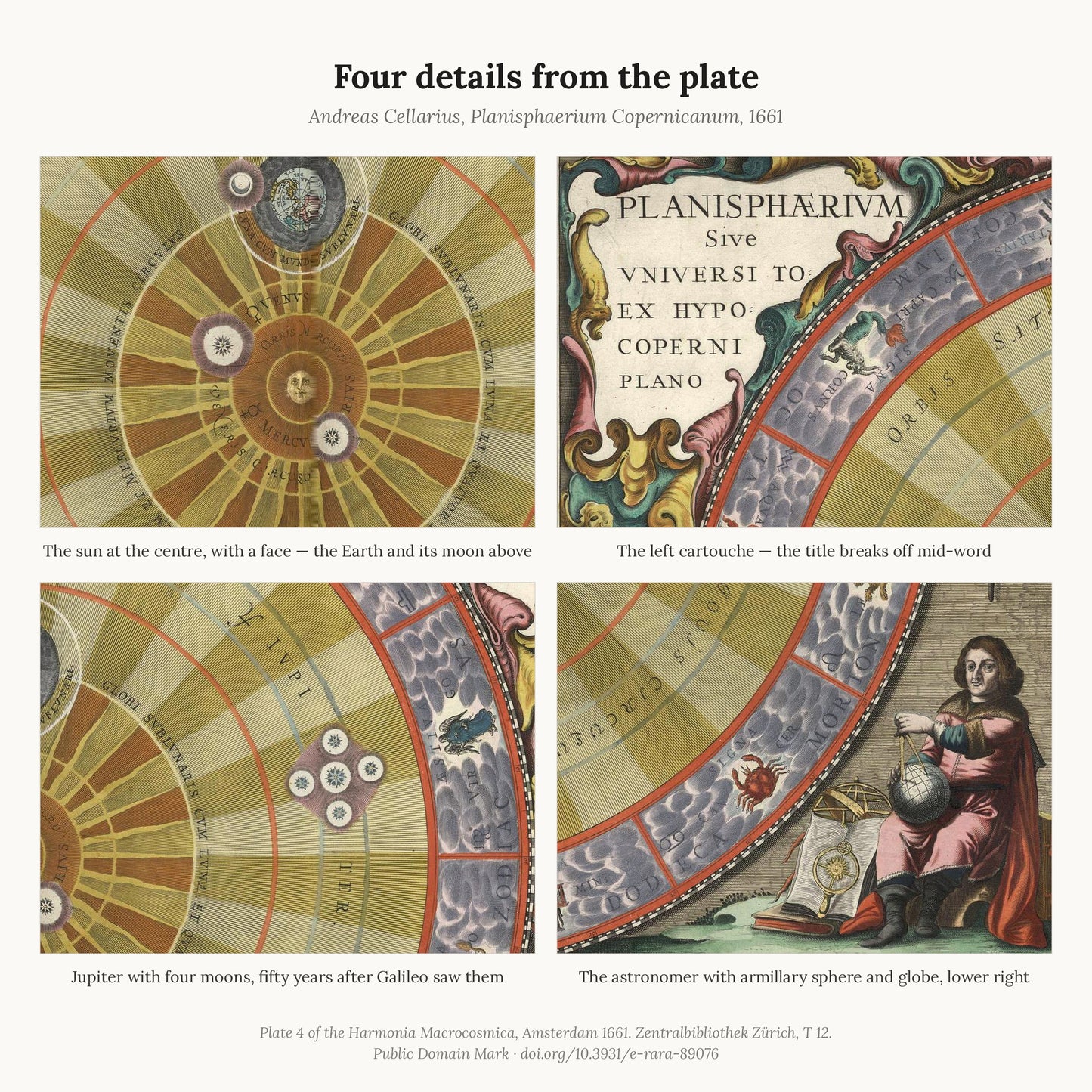
At the centre, the sun — and it has a face. Around it the circles of Mercury and Venus, then the Earth carrying its moon in a small ring of its own, then Mars, then Jupiter with four satellites, then Saturn. The outermost band is the zodiac, twelve fields of cloud with their signs. Nothing here turns around the Earth except the moon.
The title is cut in half, exactly as on the Ptolemaic plate: two cartouches at the top, read left line then right line, and single words break across the gap. The engraver made the reader's eye travel the whole width of the heavens before the sentence closes.
This is plate four of the Harmonia Macrocosmica, Amsterdam 1661 — three leaves after the Ptolemaic system, in the same volume, drawn by the same hand with the same care. Cellarius set the competing models beside one another and let each make its case. Copernicus had been in print for 117 years; Galileo had been tried 27 years earlier; and the four small discs beside Jupiter are what Galileo saw through his glass in 1610, drawn into the sky fifty years later.
Andreas Cellarius was not an astronomer. Born around 1596 at Neuhausen near Worms, he taught Latin in Amsterdam and The Hague, and from 1637 was rector of the Latin school at Hoorn, housed in a former convent. He died there in the first months of 1665. Where he is buried is not known.
The mug carries the plate whole — both cartouches, the two figures at the sides, and in the lower corners the astronomers: Ptolemy on the left with his globe, and on the right a younger man with an armillary sphere. The copy is the one kept in Zurich, coloured by hand.
The fourth product image shows four details at the size they are printed: the sun with its face, the cartouche where the title breaks off mid-word, Jupiter with its four moons, and the astronomer in the lower right corner.
Fine porcelain, 10 oz — 104 mm high, 75 mm across the base. The image runs around the body; handle and rim stay white. Dishwasher and microwave safe.
From the same series: Planisphaerium Ptolemaicum, 1661
Andreas Cellarius, Planisphaerium Copernicanum sive systema universi totius creati ex hypothesi Copernicana in plano exhibitum. Plate 4 of the Harmonia Macrocosmica, Amsterdam: Johannes Janssonius, 1661. Zentralbibliothek Zürich, T 12, doi.org/10.3931/e-rara-89076. Public Domain Mark.
Selected by Dr. Walther Fuchs for the Tazzarte collection.