Tazzarte
Andreas Cellarius: Planisphaerium Ptolemaicum, 1661 – Porcelain Art Mug
Andreas Cellarius: Planisphaerium Ptolemaicum, 1661 – Porcelain Art Mug
Couldn't load pickup availability
- ✓ Free worldwide shipping
- ✓ 30-day returns
- ✓ Damaged? Free replacement, no return needed
- ✓ Printed and shipped from the hub nearest you — no customs, no long wait
The price you see is the price you pay — taxes included, nothing added at checkout. Shipping · Returns · Help
Share
Planisphaerium Ptolemaicum, 1661
Zentralbibliothek Zürich, T 12, doi
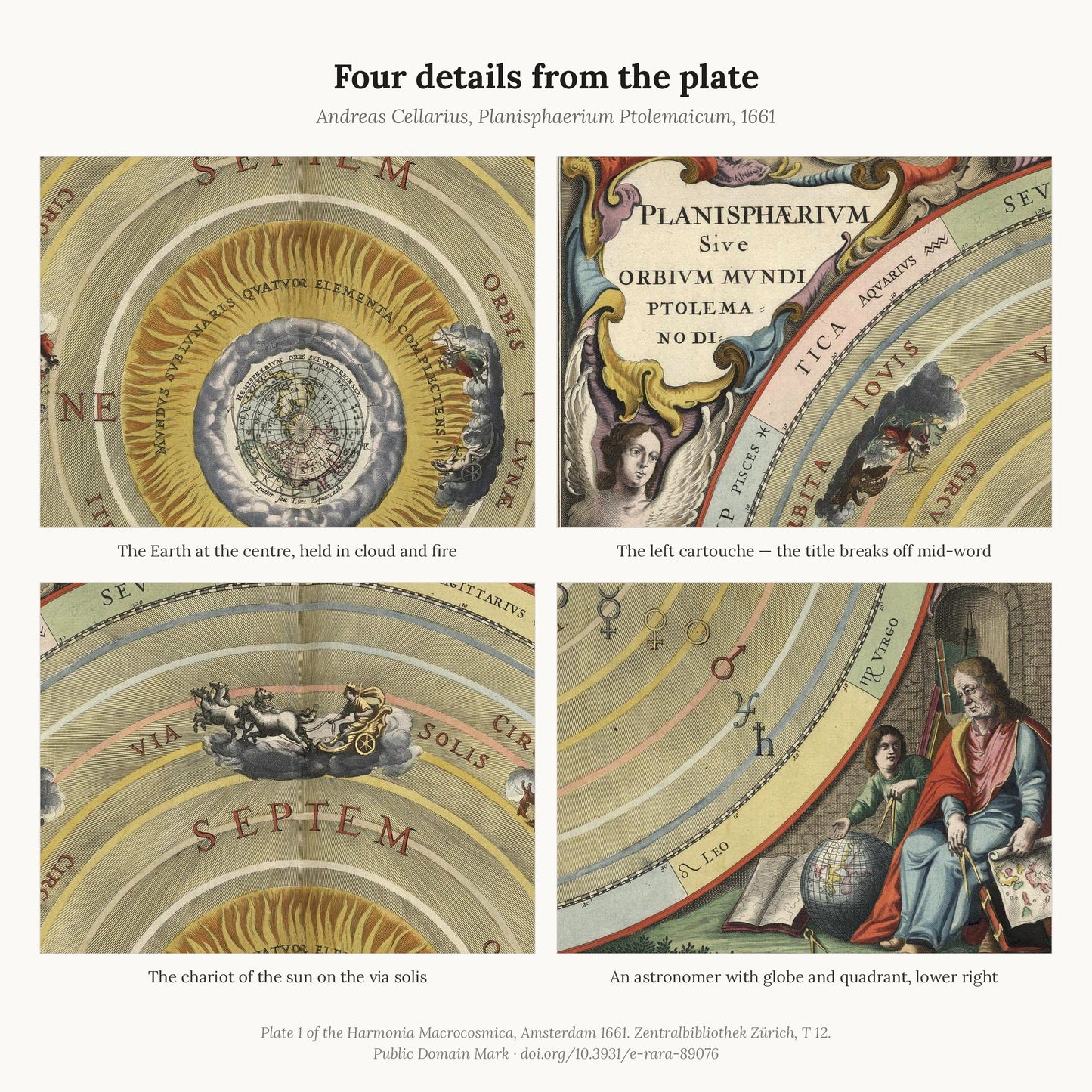
At the centre, the Earth. A small globe of the northern hemisphere — Europe, Asia and Africa named on it — wrapped in a ring of cloud and set inside a band of flame: mundus sublunaris quatuor elementa complectens, the world below the moon that holds the four elements. Around it turn seven spheres, one for each planet the age could see, each with its god driving a chariot through the clouds. The outermost band is the zodiac. Everything moves around the Earth, because in this picture everything does.
The title is cut in half. It stands in two cartouches at the top, and you have to read across the sky to assemble it — left line, right line, left line, right. Even single words break across the gap. The engraver made the reader's eye travel the whole width of the heavens before the sentence closes.
Andreas Cellarius published the Harmonia Macrocosmica in Amsterdam in 1660, and this is its opening plate. Copernicus had been in print for 117 years. Galileo had been tried 27 years earlier. The model was finished, and Cellarius opens with it anyway: the atlas was conceived as a history of ideas, and it sets out the systems of Ptolemy, of Copernicus and of Tycho Brahe side by side, each drawn on its own terms and with the same care. The sheet printed here comes from the issue of 1661; the Copernican plate, three leaves later in the same volume, is its counterpart.
He was not an astronomer. Born around 1596 at Neuhausen near Worms, he taught Latin in Amsterdam and The Hague, and from 1637 was rector of the Latin school at Hoorn, housed in a former convent. He died there in the first months of 1665. Where he is buried is not known.
The mug carries the plate whole — both cartouches, the winged figures at the sides, and in the lower corners the two groups of astronomers with their globes, quadrants and cross-staffs. The copy is the one kept in Zurich, coloured by hand.
The fourth product image shows four details at the size they are printed: the Earth held in cloud and fire, the cartouche where the title breaks off mid-word, the chariot of the sun on the via solis, and the astronomer in the lower right corner.
Fine porcelain, 10 oz — 104 mm high, 75 mm across the base. The image runs around the body; handle and rim stay white. Dishwasher and microwave safe.
From the same series: Planisphaerium Copernicanum, 1661
Andreas Cellarius, Planisphaerium Ptolemaicum sive machina orbium mundi ex hypothesi Ptolemaica in plano disposita. Plate 1 of the Harmonia Macrocosmica, Amsterdam: Johannes Janssonius, 1661. Zentralbibliothek Zürich, T 12, doi.org/10.3931/e-rara-89076. Public Domain Mark.
Selected by Dr. Walther Fuchs for the Tazzarte collection.